Course Reviews- Looking for those Hidden Gems in NJ
Finding Some "Friendly" Places to Play in NJ - Gambler Ridge Golf Course/ Cream Ridge GC/ Atlantis GC
by Sean Fawcett, updated by Marian Castner
Everyone loves a friendly place to tee it up. A place where the staff always greets them with a smile and treats them like family. Gambler Ridge Golf Course in Cream Ridge is just one of those very places. Under new family-owned management, the Collard family has invested in many improvements both on and off the golf course.
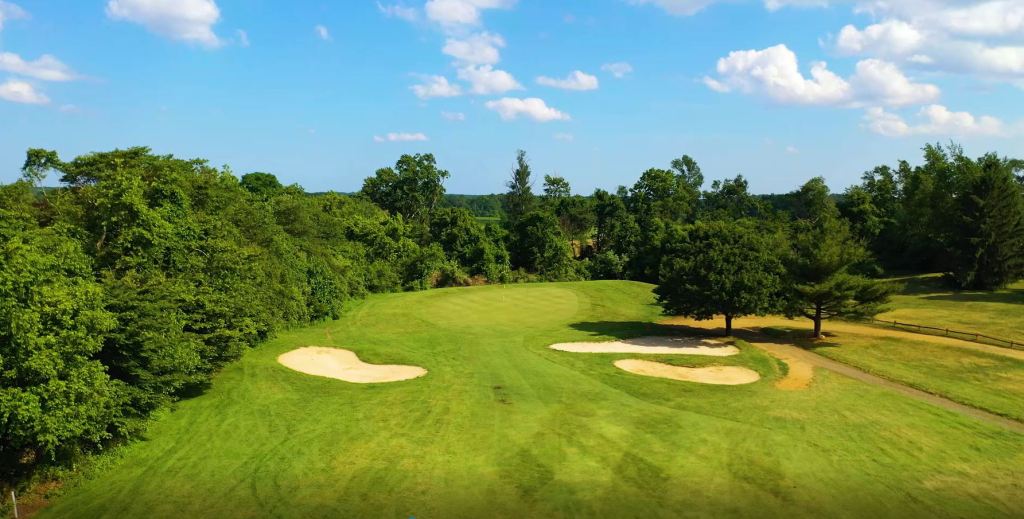
A former farm turned public 18-hole golf course and nicknamed “New Jersey’s Friendliest Golf Course," Gambler Ridge is located in horse country near Freehold Township. Given the sirene rural surroundings, it's just the type of track that all golfers love to play over and over again. Besides being affordable and thoughtfully designed, the real stars of Gambler Ridge are its extremely playable layout, laid back atmosphere and its many exciting risk-reward opportunities with rolling fairways, manicured greens and several reachable par 5s. There's even an often driveable par 4s highlighting the loop.
Gambler Ridge begins with back-to-back par 4s that the longest hitters will enjoy giving it a go on. The short par 3, third hole adds to the potential birdie barrage playing uphill at about 100 to 120 yards over a small pond to a two-tiered green sloping severely from back to front. Don't let the short distance fool you. This can be a trickly hole.
Checking out a couple of more holes, the course’s two risk-reward holes - holes 5 and 6, are both par 4s. The first of the two, the 5th, playing for a left to right fade/slice of a about 250 yards downhill boast water bordering the par 3 7th down the left with two massive bunkers guarding the front and right. The second, No.6, calls for a long draw over water about 20 yards just short of the of the green or a strategic tee shot of about 150 to 200 yards to the right to set up a wedge or a pitch approach to the putting surface. Don't miss the new patio and fire pits overlooking the 12th hole.This winter, they added new and transformed other bunkers These are just a few examples in the first few holes of the great variation and fun that you'll having playing at Gambler's Ridge.
Following a fun day of golf, be sure to visit the renovated Gambler Bar and Grill and reflect on your round with a cold beverage and a burger or a cheesesteak or a humongous Bavarian pretzel with cheese sauce, or any number of the other scrumptious selections from their popular Pub-style menu. There is also a daiuly happy hour with weekendspecials and live music each week during the season.
“Our facility is the perfect blend of picturesque scenery, hospitable service and friendly atmosphere,” said Gambler Ridge Golf Course Assistant General Manager John Cereste. “ At Gambler Ridge, many visitors say they feel like family and form many lasting friendships and memories through their experiences with us. We take special pride in that.”
Not far up the road, that very same familial-type feeling can be felt at Cream Ridge Golf Course, as well. A CORE GOLF property managed by golf professional Bob Lowrie and PGA pro Kevin Figa, Cream Ridge GC in Cream Ridge, near Allentown, offers a terrific, challenging and fun golf course with ultra-friendly and top-notch customer service making for a memorable and enjoyable day on the links.
“Cream Ridge was a family built and run golf course and continues to be,” said General Manager Lowrie. “ Our #1 priority is to treat people like friends and have them just enjoy their time here.”
Meticulously maintained by Course Superintendent Mark Stallone, with ongoing improvements entering its 3rd year of renovations, Cream Ridge is a fair and scenic course that all players of all levels can play and like coming back to over and over again.
Together with its fine, first-rate restaurant, The Roost, featuring classic pub fare and up-scale dinners to suit every taste, Cream Ridge Golf Club satisfies a golfer’s every wish making for a tremendous, and all-around, golfing experience.
“It’s all about the whole experience,” said Lowrie. “ We strive very hard to treat people nicely and have a really nice course for them to play with a great place for them to come and eat.”
If you heading a little further south, put on your list to play another very friendly place to tee it up is The Ocean County Golf Course at Atlantis in Little Egg Harbor.
A county-run course since the late 1980s, Atlantis opened in the early 60s as a private country club designed by Merion US Open runner-up to Ben Hogan, George Fazio, and features several very memorable, and fun-to-play, holes like its signature par three 6th. Modeled after the more famous, and sometimes infamous, #12 at Augusta National(Golden Bell), Atlantis’ challenging 6th plays left to right over water and a massive sand trap to a narrow, sloping green. Playing about the exact same yardage as Augusta’s 12th (145yards), players get to try their skill, and nerve, playing a par 3 just like the very best in the world get to do two to four times every April at The Masters.
The par 4 18th is maybe the most challenging finishing hole in all of Ocean County. Atlantis’ finishing hole plays straight uphill to a treacherous two-tiered green perched some fifty feet above the players’ head.
Additionally, Atlantis features a 200-yard driving range, a chipping green with sand trap and full-sized putting green with the Ocean County Vocational School’s culinary restaurant, Cuisine on the Green, which provides fine food, pub fare and beverages inside and out on the patio by the first tee.
“Atlantis is a hidden jewel in southern New Jersey,” said Pro Shop Witkowski. “ Although our course is challenging, our entire staff takes great pride in knowing that their level of service brings our visitors back again and again.
“Our “family” of regulars have stories that go way back and now their children and grandchildren play here as well.”
Hopefully, I've peaked your interest in three of our "friendliest" courses in New Jersey. Golf is a friendly game which promotes many values, including fair play and friendship. Courses like Gambler Ridge, Atlantis, Cream Ridge, are three great places to start. Take a chance and play these three this season!
Cream Ridge GC
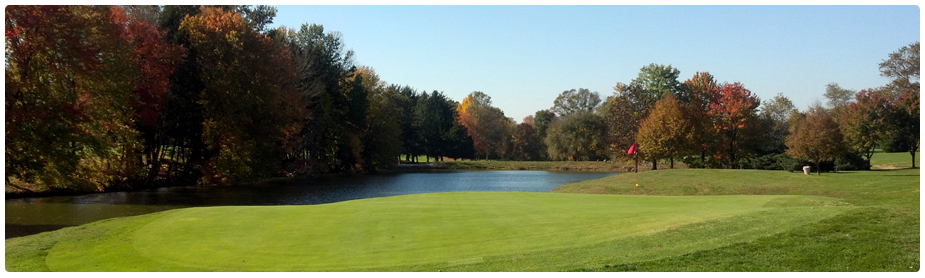
Atlantis Golf Course

Gambler Ridge Golf Course
--------------------------------------------------------------------------------------------------------------------------
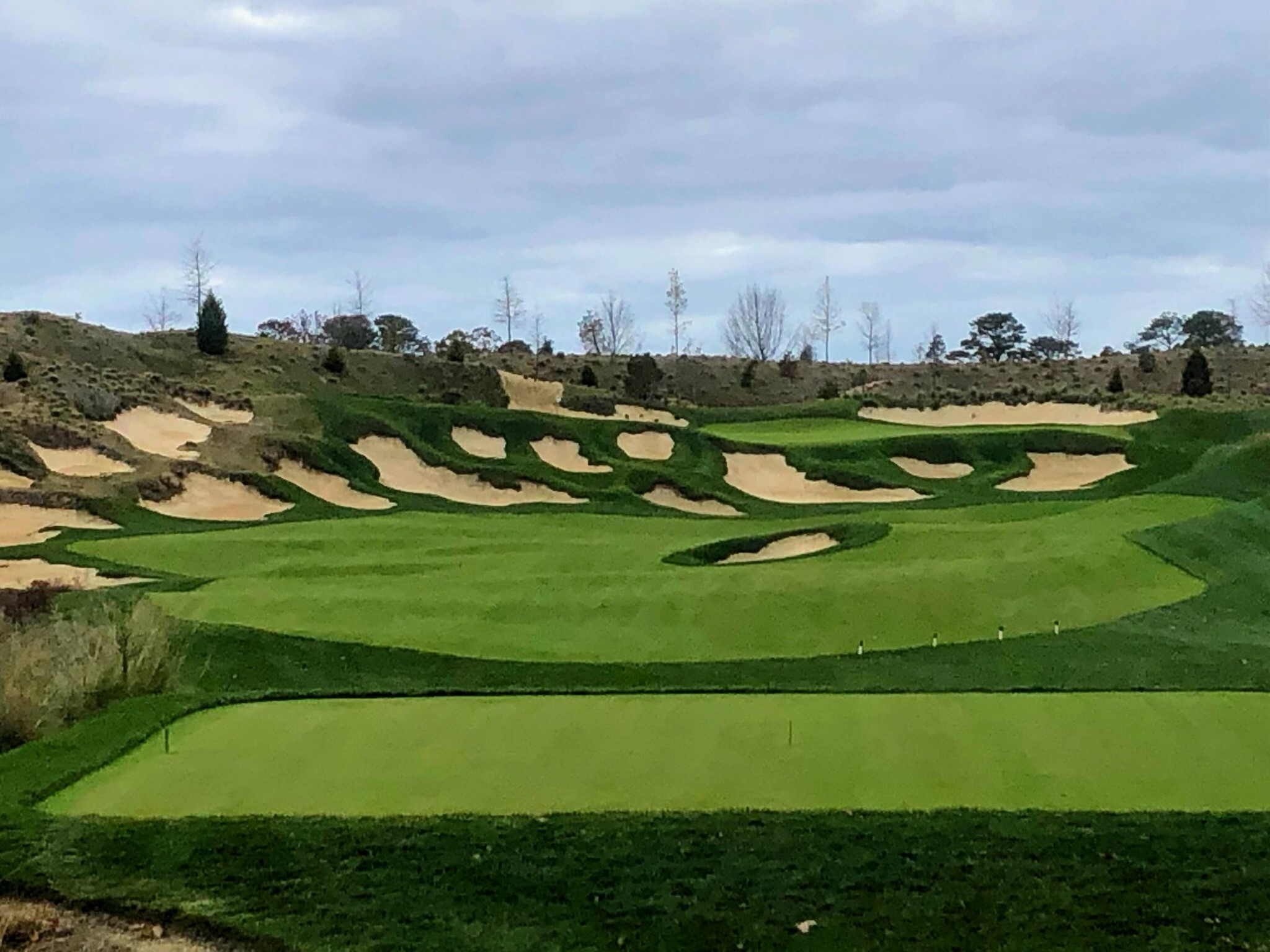
Photo courtesy of Sean Fawcett and Emily Cosenza
Photo courtesy of Sean Fawcett & Emily Cosenza
Golfing in the Pinelands
Reviewed by Sean Fawcett, December 2025
New Jersey’s Pinelands region offers some of the most enjoyable and character-rich public golf in the state, blending natural beauty with thoughtful course design. Two standout examples are Pinelands Golf Club in Hammonton and The Links Golf Club in Marlton—each offering a distinct yet complementary Pine Barrens golf experience.
Pinelands Golf Club, originally built in 1964, is a classic tree-lined layout set deep in the heart of the Pine Barrens and blueberry country. Designed by Ralph Leopaldi with input from Arnold Palmer, the course features strategic bunkering, water hazards, and subtly sloped greens that reward smart shot-making. Recently acquired by New City Equities, Pinelands has continued its renaissance following major improvements made by the DiDonato family, including course enhancements, a renovated clubhouse, the Twisted Tavern restaurant, and the Cart Barn event space overlooking the first tee. Now rated a Top 20 Public Course in New Jersey by NBC Sports, Pinelands blends traditional design with modern upgrades and renewed energy.
The Links Golf Club in Marlton offers a different, but equally appealing, take on Pine Barrens golf. Set within the King’s Grant community, this semi-private course features rolling fairways, well-placed bunkers, and pristine greens in a welcoming, player-friendly environment. The layout encourages strategic play while remaining accessible for golfers of all skill levels. Known for its excellent conditioning and relaxed atmosphere, The Links also emphasizes environmental stewardship through sustainable course management. With a comfortable clubhouse, pro shop, and casual dining options, it delivers a complete and enjoyable golf experience.
What connects both courses is a commitment to preserving the natural character of the Pinelands while enhancing the golfer experience through thoughtful investment and care. Whether you prefer the historic charm and recent revitalization of Pinelands Golf Club or the polished, community-focused appeal of The Links Golf Club, both represent two "hidden gems" in South Jersey golf.
With so many great options in the region, these two courses stand out as must-play destinations for anyone looking to experience golf in the Pinelands.
A Brand New Pomona Golf Club
Reviewed by Sean Fawcett, October 2025
“Night and day” is the only way to describe the incredible transformation of Pomona Golf Club, a longtime Pine Barrens favorite.
Some golfers tend to overlook “executive-style” courses, assuming shorter means less challenging or less enjoyable. But Pomona—where even its five longest holes measure only about 300 to 365 yards—proves that assumption wrong. This is a one-of-a-kind, thoroughly enjoyable, and surprisingly satisfying golf experience that every golfer should give a real chance.
Open for more than 80 years, Pomona was originally established as one of New Jersey’s first African-American-owned golf clubs by local entrepreneur Sarah Spencer Washington, founder of Apex Beauty Products in the Atlantic City area. Though founded with that distinction, it has always welcomed golfers of all backgrounds. Today, under new ownership and featuring a completely refurbished public clubhouse, bar, and restaurant, Pomona Golf Club is once again a standout destination along West Moss Mill Road in Egg Harbor Township near Galloway.
The new ownership group—featuring members connected with McGettigan’s 19th Hole at Seaview and Costello’s Pizza—along with General Manager Gina Cafone, Director of Golf Zach Sterr, and Superintendent Dylan Plantarich (formerly of the 1912 Club and historic Lulu Country Club), is bringing bold, fresh energy to the property.
“The goal, the dream, is to make a local spot, a hidden gem, and bring it back to life,” said Sterr, a lifelong Galloway Township resident. “There’s nothing around like her. The course is different and has a rustic, homey feel. People of all ages and abilities can learn and enjoy playing here anytime.”
A major catalyst for Pomona’s rebirth is its brand-new irrigation system, installed this spring. It’s already paying off with dramatically improved turf conditions and far healthier fairways.
“She has good bones,” Plantarich said. “She just needed some care and a good watering system.”
Additional enhancements continue to shape Pomona’s comeback. The former sharp dogleg-right opening par-4 has been reimagined as a par-3, balancing the scorecard with three par-3s and six par-4s. Work is also underway on improving the driving range—the only public range within roughly five miles—and building a brand-new practice putting green near the First Tee.
Off the course, Pomona is expanding its parking area and introducing the “10th Hole” Bar and Grill, which offers a refreshed menu featuring hot and cold sandwiches, smash burgers, salads, and tacos.
Among the standout holes, the dogleg-right par-4 Fourth Hole remains a personal favorite. The approach requires carrying a bunker short and left, with another guarding the back of the green, which subtly angles right-to-left from front to back. It’s a fun, strategic challenge.
A favorite hole is the 125-yard par-3 Seventh Hole—the first of the three closing holes across Moss Mill Road—is another highlight. Just a wedge or short iron, the hole demands a high, straight shot to hold its tiny, narrow green and set up a birdie chance.
I have countless fond memories at both Pinelands and Pomona, and I know many more will follow in the years ahead. You’ll make your own, too—so make it a point to give Pomona a try, or try it again, whenever you can.
(All rights reserved to Golfer's Tee Times)
Robert White: A Forgotten Giant of Golf Course Architecture
By Sean Fawcett - NJ Golf News Senior Writer
One of the overlooked figures in New Jersey golf course history is Robert White. Even among enthusiasts, his name is not always widely recognized, yet his impact is undeniable.
Born in St. Andrews, Scotland, in 1876, White began his career as a schoolteacher before emigrating to the United States in 1894 to study agronomy at the University of Wisconsin. Like many Scottish immigrants with a love for the game, he found work as a greenskeeper, clubmaker, and eventually as a golf professional. His résumé included posts at Myopia Hunt Club in 1895 and Shawnee Country Club in 1914, before turning more fully to course design.
White’s influence extended far beyond architecture. He became the first president of the PGA of America in 1916, guiding the new association through the final years of World War I. He also co-founded the American Society of Golf Course Architects and helped many young British professionals find work in the U.S. Later, in 1954, he designed the first White House putting green for President Dwight D. Eisenhower. In recognition of his contributions, he was inducted into the PGA Hall of Fame in 1994.
Although not as prolific as Donald Ross or A.W. Tillinghast, White designed roughly three dozen courses during the Golden Age of Golf. His work is found in Ohio, New York, Pennsylvania, Connecticut, and South Carolina, where he lived until his death in 1959. In New Jersey, his best-known design is Manasquan River Golf Club, along with Green Brook Country Club in North Caldwell.
At Manasquan River, White created a course of contrasts. The front nine, opened in 1923 on the meadows and pastures of the Osborn family farm, plays with a parkland feel. Three years later, the back nine opened in the higher ground and ravines above the river, evoking a more Scottish, links-style character. Together, the two nines form a course that shifts in mood and challenge, offering both wooded holes and riverside stretches with expansive views.
Two holes in particular illustrate White’s design philosophy. The 7th, a par five of nearly 660 yards, requires strategic placement just to cross a ravine before tackling a plunging fairway. The 16th, a demanding par four of 465 yards, asks players to carry the Manasquan River on the approach to a green perched dramatically above the water.
As Christopher Dymek, Manasquan River’s longtime PGA professional, puts it: “There isn’t a bad hole out there. Robert White made a masterpiece at Manasquan.”
Robert White may not have left behind the same number of courses as his more famous contemporaries, but his blend of Scottish minimalism and American ambition produced enduring work. His designs — especially at Manasquan River — remain a testament to his role as both a builder of courses and a pioneer of professional golf in the United States.
Photo and additional information provided courtesy of Christopher Dymek - Manasquan River Country Club. All rights reserved.


Union League National Golf Club - A Masterpiece in the Making
Reviewed by Sean Fawcett, njgolfnews.com senior writer
Imagine being there when the Eiffel Tower was being erected, or when DaVinci was painting The Last Supper, or when Michaelangelo painted The Sistine Chapel, or when The Beatles recorded Sgt. Pepper, or when The Boss, Bruce Springsteen, and his E Street Band first played The Stone Pony in Asbury Park. Imagine that, if you can, and you will sort-of know what The Union League of Philadelphia’s members and their guests are feeling and seeing, when playing at the new Union League National Golf Club.
Now in its third year of renovations, Union League National just north of Avalon in Swainton, NJ, was formerly Sand Barrens Golf Club but you'd never know it. It’s being totally and almost unbelievably reimagined by its original Sand Barrens architect, Dana Fry, and his partner Jason Straka, into one of the elite golf courses in the entire country.
Fry and Straka have worked together for more than twenty years on award winning projects all over the world. Fry is the architect of Erin Hills which hosted the 2017 US Open, and New Jersey's own Hamilton Farm Golf Club. He credits much of his work to his former co-designer and mentor the late golf course architect and artist Mike Strantz, perhaps best known for his work at Tobacco Road near Pinehurst, North Carolina and Caledonia Golf and Fish Club near Myrtle Beach. They came up through the ranks with world renowned architect Tom Fazio.
Fazio's concept behind this new Union League National is to create one of the best in the country, inspired by two great golf courses, New Jersey’s iconic Pine Valley and Fry’s design at Calusa Pines in Florida.
"The course is totally unrecognizable from when it was Sand Barrens," said Union League National Golf Club General Manager Jacob Hoffer. "Lakes ponds and creeks, plus vast waste areas and creative vertical elevation, all create so much more drama than there was here before."
"There’s a little of Pine Valley and Calusa Pines, Dana's course from down in Naples(Fla.)" added Hoffer. "Put them both in a blender and you have the new Union League National. It's a great course and a sight to behold."
One of the most memorable "attractions" to see at Union League National Golf Club is the "Big Fill. "At its highest point, it reaches a height just over 78 feet above sea level. The existing ground was around 18 feet above sea level, meaning close to 60 feet of fill were brought in. The "Big Fill" is modeled after a somewhat shorter 48- foot fill at Calusa Pines. It is a sharp, vertical man-made mini mountain that covers over 45 acres and was constructed from the dirt when digging out Union League’s brand new lakes, ponds and creeks.
The Big Fill towers over the Union League's 27-hole facility. Each of the three nines is named after a Civil War Union general– Ulysses S. Grant, George Meade and William. T. Sherman. From it, one can see many awe-inspiring and totally breath-taking views of multiple tees, fairway and green complexes.
"The Big Fill is the primary, and most prominent feature of the course," says artichect Fry. "You can see the whole course from the top. Everything just spreads out from underneath you from the summit of the Fill."
Besides the Big Fill a massive year-long strategic tree, native grass and wetland plants revegetation project was implemented by Jason Straka. Over one million plants were planted, including regional grasses and shrubs like broomsedge, switchgrass, bayberry, different varieties of sedges, bearberry, scrub areas and all around the course with more to come. While this project still has years to go and really is still in its early stages, the ultimate aim of all the new growth is to return the property to its natural forested condition and surroundings and create a feeling similar to the one that golfers get at courses like Pine Valley, Bandon Dunes, Friar’s Head, Sand Valley and Pinehurst #2 get when playing those iconic and very natural landscapes.
Additionally, creating the Big Fill dug created some interesting and unique features to several of the par 3's and 4's. For instance, on the fifth hole on Meade, one of the par 3's plays through two ridges downhill to a slender green fronted by water. The two man-made ridges on the hole creates a cool canyon-like atmosphere that will challenge golfers of all levels, including low handicappers and professionals.
On the eighth hole, also on Meade, is a straight uphill, and occasionally drivable Risk/Reward Par 4 with bunkers, which need to be avoided, all around the fairway and green. The hole measures just 306 yards. It tees off right below the halfway house and plays uphill about 25 feet. Long hitters will have a gutsy decision of whether to go for the green or more probably, get up-and-down from one of the greenside bunkers. Otherwise, play more prudently and lay-up off the tee to try and set up for a full wedge or get imaginative with a straight-forward, but also extremely tricky, bump-and-run approach.
Several other holes at the twenty-seven hole facility offer many more Risk/Reward opportunities with reachable greens and split fairways forcing players to have to think and aim and play strategically. This adds to the fun and challenge of Fry/Stranka's absolutely jaw-dropping and significantly improved Union League National layout.
"Pine Valley and Calusa Pines are the inspiration," said Fry. "The great thing about those two courses, and Pine Valley in particular, is that they just look so natural that they look like they’ve always been there.
"The soil is the very same sand-based soil as the Pine and Oak forested terrain you have where Pine Valley is located less than an hour away.
"Our goal is to make it look so natural that you can’t tell that it was actually built. My hope is to be around in 30 years to see it when it is all grown and fully mature. This is one of my all-time favorite projects. It's really going to be something very special."
Without a doubt, Fry's comments were hyperbole; it’s just a fact. Union League National is a masterpiece, and it will, in the not too distant future, be thought of right along the likes of America's finest golf courses.
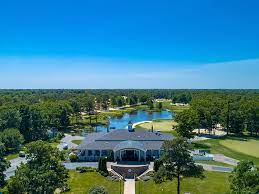
Courtesy of Union League National Golf Club
All rights to these reviews are reserved by Golfer’s Tee Times/www.njgolfnews.com 2025-26